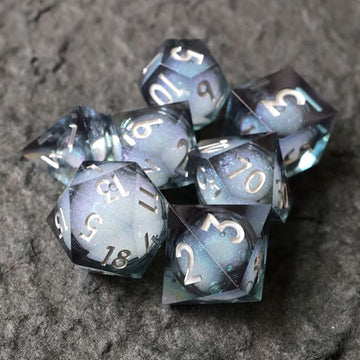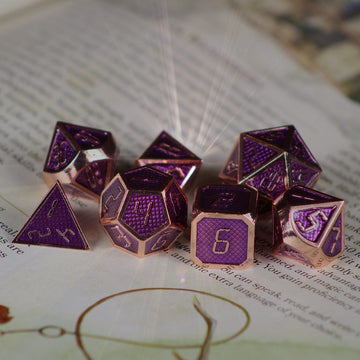


Title image © Gavin O'Donnell
Exploring TTRPG First Principles
Part 1/7: My Predicament and an Introduction
This post is part 1 of a 5 – 7 part series on "Re-evaluating TTRPGs." It is more about theory and perspective than practical advice. It is written less as a "how to" guide and more like a journal entry. If that is not your cup of tea, I suggest reading this post on Spell Duels or shopping for some truly magnificent sharpedge dice here.
"I can't wait to NOT play DnD anymore..."
That's what I said to myself back in August 2025. I had been a full-time DM since 2019, running two campaigns just about every other week. But now, with my first baby on the way, I was stepping away for a while to enjoy a well-deserved "Dungeon Master sabbatical."
It was presented as practical necessity. Which is true! I don't know if you know this, but babies are kiiiiiind of time-consuming. And energy-absorbing. And emotionally overwhelming. And cuteness overloading. But also, I NEEDED a break; baby or no baby, I couldn't put it off any longer.
I was BURNT OUT.
For years, I looked forward to every session, eager for the weekend to be over so I could get to DnD. But by summer 2025, I would roll my eyes on Monday afternoon and lament my TTRPG plans that evening with a heavy sigh. It just wasn't FUN anymore.
Now, that wasn't a huge surprise. Burnout isn't reserved for menial jobs. More often than not, it's the things you are passionate about that push you over the edge of exhaustion.
But in this case, I didn't feel like my burnout stemmed from frequency. We only played once a week, and probably ⅕ of them were cancelled due to some sort of scheduling conflict. It's not like I was running 3 – 4 different, in-depth, totally open-world campaigns.
Also, I (mistakenly) considered myself a DM who avoids "overdoing it." Over the years, I have created structures, frameworks, and outlines to help make session and campaign prep easier. Heck, I've written about it on this site. Examples here and here).
And yet I was not only exhausted... but APATHETIC as well.
The DM stuff that used to excite me instead just felt like an annoying and costly chore. Everything... game prep, worldbuilding, plot and story structure, building combat encounters... felt tedious, convoluted, and time-consuming.
And that was just prep. At the table, I had to really exert myself to lead with energy and tone. Not to mention role-playing; I lacked enthusiasm for whimsy and stoic NPCs like.
Needless to say, I welcomed by DM sabbatical with open arms:
- Finished some much-needed work around the house
- Welcomed a new baby boy (we'll call him "Mr. Clairvaux")
- Raced to improve my site's SEO before the holidays
- Focused on physical therapy for my f-ed up ankles and achilles
- Enjoyed some great family time for Christmas
But a sabbatical is not just rest... it is also REFLECTION.
Here and there over the past 4 months... I would return to campaign prep. For example, while bedridden from a minor surgery, I completely re-did the back half of one of my more railroad-y campaign plots. I got some new maps and tokens on the VTT. And I always keep a mini notebook to jot down ideas while on a walk or while waiting for a coffee.
But still... something had to change. There was still something frustrating about how I planned. Stuff wasn't clicking. Ideas weren't flowing. Objections seemed to meet me at every turn. I realized that if I approached DMing the same way as I did the past few years, it would not be long before I was once again bored, tired, and frustrated by TTRPGs.
There is SOMETHING wrong with how I view prepping, running, and playing TTRPGs.
So I began reflecting on my past campaigns. I considered how I approached campaign prep and session prep. I thought about how I interacted with players. I read and watched some top notch stuff from TTRPG content creators (the greatest... of course... remains Angry GM, but I digress...).
And what I discovered confirmed my suspicion: I WAS THE PROBLEM.
Ok, that is a bit harsh.
But it's better than coming to the conclusion that TTRPGs suck. Or that my friends were just "bad at playing" or some hella judgy perspective like that. Or thinking DnD 5e was the problem and forcing my tables to learn and convert everything to a new system. Or just abandoning campaigns altogether.
My problem was my vague, incoherent "DnD philosophy."
I have not been quiet about my criticism of WotC and 5e, particularly their exploration and travel mechanics. But I knew mechanics were not the issue, because I knew that all my problems would remain even if I found a new rules set. I realized that no amount of tinkering with rules or systems was going to satisfy my lingering TTRPG malaise.
The issue wasn't mechanics... it was philosophy. How I understood the game, myself as a DM, and the players was flawed. The relationship between characters and dice and the world was out of sync. And most importantly, my expectations were not aligned with my actions and attitude.
And because my assumptions were incorrect, or my perspective was limited... or whatever... all my effort as a DM was like trying to smash down a brick wall with my bare fists. Or trying to force a square peg into a round hole. And it is THAT stuff that burnt me out.
Like most DMs, I am mostly self-taught. And the danger of being self-taught in anything is that you often skip learning your first principles. But the masters call them FIRST principles for very good reasons...
It's time to learn some foundational fundamentals.
So I texted my two campaigns, told them I would need a few more months of sabbatical to rethink, replan, and prep. They didn't mind because they have continued playing in my absence:
- One of them heroically snatched the baton and is a first-ever DM tackling Mines of Pandelver.
- The other begrudgingly accepted the responsibility by......... dumbing down his 30-person murder mystery parties he writes to accommodate 5 people in a Call of Cthulhu set in Victorian London.
Needless to say, they are perfectly content, and my overthinking melancholy is not missed.
Which is great because it gives me plenty of time to rethink how I approach TTRPGs.
That is what this blog series is, and what this long introduction has been leading up to. Over the next few weeks, I am going to do some further research., And over the next few months, Awesome Dice will post some of my thoughts. As of writing this, topics will include:
- Clearing the air with definitions of key TTRPG terms
- Exploring why stories matter and (maybe) how they work
- The "randomness problem" for TTRPG storytelling (and sports!)
- How video games help... and hurt... our expectations for TTRPGs
- The tension between a "game" and a "story"
- The importance and place of player agency
This will not be a "Complete Guide" or an "11 Tips for Players..." type of blog series. They are more like journal entries than essays. Rather than making an argument, I will be stating what something is, my observations, and sharing my opinions.
As of now, I do not think it renders any of my previous blog posts irrelevant. I still stand by those homebrew mechanics and guidelines (YES, MR. LEWIS... THE CHASE RULES AND DARKVISION RULES ARE COMPLETE BUT GREAT!!!). I've only begun my reading and thinking, but so far it seems like there was always part of me that believed that story came from gameplay...
So if you are in a similar space, are equally curious, or just stumbled upon this post while shopping for Ranger dice... I welcome you to my humble journey to become a better DM and enjoy TTRPGs more.
Riley Rath

Riley is a freelance tabletop games copywriter, content writer, and marketer based out of Spokane, WA. When not playing or writing about board games or DnD, he is busy with family, hiking, cooking, and gardening... very hobbit-like for a 6'4'' dude. Are you hoping to run a tabletop games crowdfunding campaign? He can help! Click the link to learn more.