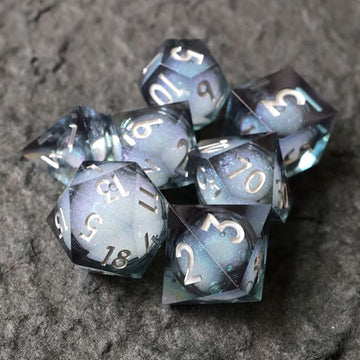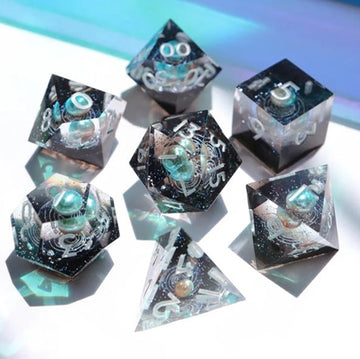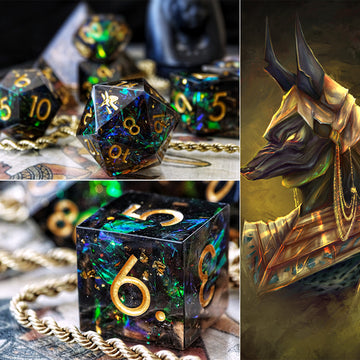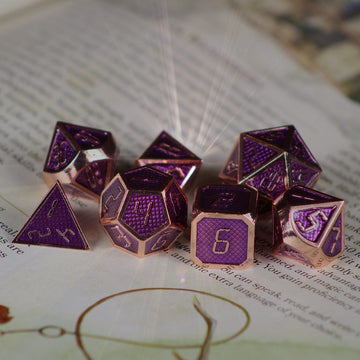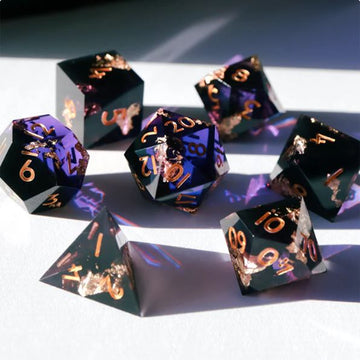


Title image © Roberto Gatto for Supernova Collective
What Even IS a Tabletop Role Playing Game?
Part 2/7: Defining the Key Terms that make a TTRPG
This blog post is part of a series exploring the essence of TTRPGs.
None will be an optimized, all-inclusive, "ultimate guide" type post... I am not making an argument. They are more akin to journal entries; an invitation to join me as I reconsider TTRPGs by examining the core principles.
But before I do all of that, I wanted to establish some working definitions. You can't have conversations with anyone unless you agree on the terms!
What Is a Tabletop Role Playing Game?
"Dungeons and Dragons fifth edition is a fun, table-top role-playing game where players engage in cooperative storytelling to experience an epic adventure. Dungeon Masters creatively make a world for players to freely explore and make meaningful decisions. Players choose from play tested, balanced classes to create unique characters they role-play. Some wield weapons, some cast spells from schools of magic. Often they get into combat, with players taking turns, one after another, with actions and bonus actions, as well as reactions, until combat is resolved."
In a previous post on fixing/improving 5e Counterspell, I used the above definition for Dungeons and Dragons (fifth edition). That still works for 5e. But not only can it benefit from some addition by subtraction, but a new definition to cover all TTRPGs would need to be more generalized. Other popular tabletop roleplaying games include Call of Cthulhu, Pathfinder, Blades in the Dark, Vampire the Masquerade, and GURPS.
And... unfortunately... I cannot write a new one at the moment. That is kind of the point of this whole series, to figure out HOW to write a new definition.
Yes, a tabletop role playing game is a type of game. It's an RPG hobby. It's a reason to socialize. But to get a helpful definition... one that gets to the heart of what makes a TTRPG special and guides me/you/us toward enjoying TTRPGs better... I need to research more. However, what we can do is move closer to understanding by parsing out some of the key terms.
Note: And don't even try with LLMs... already did... their definitions are a stinky pile of uninspired garbage.
"Tabletop"
The "tabletop" part of the game means exactly what it says: the top of a table. Usually a large table filled with things you need like character sheets, some pencils, and dnd dice. For decades, 99.99% of tabletop role playing games were played in person, face-to-face (exception: play by post). I remember a podcast talking about how the sitting around a table and imagining an adventure was akin to a seance... but we don't want to validate the deluded Satanic Panic crowd, so we will leave that for later.
But what can you do if your group can't play in person? You can still play TTRPGs via a virtual tabletop (VTT). These are apps and platforms that enable people to play virtually. They often include video and chat features, a map, and all sorts of additional tools (maps, lighting, stat blocks, etc.).
While one could argue VTTs are categorically different from playing around a tabletop... I have friends that refuse to play unless it is in person... I would say it still falls under the umbrella of a true TTRPG experience.

© Massimiliano Haematinon Nigro
"Role-Playing"
Roleplaying is playing a role. Performing and acting as a character. Tabletop role playing games often include speaking in an accent or new voice, taking on that character's beliefs, and choosing to view the adventure from the character's point of view. Since there is no script, nearly everything is improvised. Your role playing is a reaction to the events of the game as they happen. You just think, "What will my character do?" You pick what someone with these personality traits and goals would try. You are making it up as you go.
Your character is not "real" in the same sense that you are. You are stepping into the role of a fictional person. Which means that pretending is at the heart of TTRPGs. It is a game of make believe. But this is the first of many unique elements of TTRPGs: participants are both players AND characters. They shift between social interaction with their friends and pretending to be their adventurer. They are not stuck as their character and then taken back into consciousness when the session ends.
"Game"
This is the most important part of the definition: above all else, a TTRPG is a game. While it may result in many other things... a creative outlet, hilarious moments, an exciting story... it is first and foremost a GAME. The "tabletop" and "role playing" qualify what kind of game it is.
Now, I do not want to dive into the depths of ludology, but there are some basic aspects of what makes something a game. It is a temporary pausing of the normal rules of life. For a time, participants agree to abide by certain rules in order to achieve particular situations, realities, and existences. That is all fancy talk for: "People agree to rules so that the game feels like a game instead of wacky nonsense."
Each tabletop role playing game also has their basic rules and rule books. However, unlike many other games, many of the rules are not about what players can and cannot do. Rather, they are game mechanics dictating how players can do whatever they imagine/whatever the game master wants. This is the primary differentiator between TTRPGs: they have different mechanics. And these different mechanics result in different styles, forms... "flavors"... of the tabletop role playing game experience.
Beyond rules, a game usually has some form of gameplay. In most board games, players take turns. In many card games, players often play simultaneously. In sports, sometimes the defense can score, other times only the offense can score. In DnD 5e, the gameplay is usually the following formula repeated indefinitely:
1. DM narrates or explains a situation
2. The players ask questions
3. The players declare an action
4. The DM determines what they must do to accomplish that action
5. The player rolls dice
6. The DM determines what kind of success/failure the player has based on the outcome of that dice roll.
7. (REPEAT)
The final game element of TTRPGs are the dice. The vast majority of TTRPGs include dice as a necessary component to execute the mechanics, so we will include them as "essential." They are not just shiny accessories.
Dice = Randomness. Unpredictability. Suspense.
The presence of dice within a TTRPG campaign are what prevent the campaign from being in control of the DM or the players. They are at the heart of randomness in every TTRPG. Each time you roll the dice, you add some uncertainty and chaos into the game. You can make the best plan, but a bad dice roll can make things go wrong in a funny or big way. Dice prevent TTRPGs from being pure improv or scripted storytelling.
"Game Master" (GM) / "Dungeon Master" (DM)
While I have defined each part of a "TTRPG," there are a few more terms that require definition in order to get to the bottom of what a TTRPG is. First and foremost: the game master.
Every game... even a tabletop role playing game... needs someone to guide it. In other games the board rules, official, or referee is the arbiter of right and wrong. They determine what is legal and illegal. In TTRPGs, that is the game master's job.
The GM is the player who makes the game work, and they do so in three ways:
1. Arbiter: As stated above in gameplay, the GM dictates how/if a player can perform an action. This is known as adjudication. For example, can you use a frozen fish as a club? The GM decides. The referee job helps the game keep moving without any problem. They also keep track of the rules.
2. Storyteller: They do not write a script for the players. Instead, they create moments and then see how the actions of their characters change things. The GM shares hooks and different plot points, but the players have to pick which way to go. They come up with challenges.
3. Worldbuilder: They create the adventure and tell you what that world is like. The GM controls all the non-player characters, or NPC. An option element of worldbuilding is not just making the world come alive, but actually creating the entire world. As a DM you CAN make up a whole adventure setting from scratch... maps, history, politics, races, and all. But it is not necessary. Since many DMs rely on adventure modules, I do not find this element of worldbuilding to be an essential aspect of a tabletop role playing game.

© Blake Rottinger
"Players"
On the other side of the GM screen, you will find the players. They are called players because they are playing a game. Though character creation is a common first step, some TTRPGs start out with pre-created characters. But players ALWAYS play their own character. They take a character sheet and add quirks, backstories, and stats that help set their fates with dice rolls. The process mixes imagination with some strategy.
Every player gets to control one or more player characters, also called PCs. These player characters are the main part of the story. When you are a player, your job is to step into your PC's shoes and make choices for them.
Because TTRPGs are a game, I cannot overstate how important it is that players have agency. "Player agency" means players have the power to choose things that will really affect the game. Their choices, actions, and the consequences determine what happens next. Of course, there are elements that oppose the player; challenges they must overcome. This is the same in sports, board games, and video games. In other words, you cannot have a "game" unless the participants are confident in their agency.
Other Essential Key Terms
- Immersion: This refers to the state of the participants "experiencing" the adventure. "Being there." The state where they are "fully absorbed" in the world and story moment.
- Escapism: Nearly all tabletop role playing game settings are fantasy, adventure, sci-fi, or some unique combination of the three. This is because most people use TTRPGs to escape the mundane of life for something heroic, daring, horrifying. They use TTRPGs to experience something new and different from their everyday life.
- Imagination: While there may be lighting, music, minis, concept art, maps, and terrain... all of these are present to impact the place where the adventure takes place: in the mind of the participants.
- Creativity: Whether you are making a unique character, homebrewing your own set of rules, finding new strategies, inventing a whole new game world, or simply experimenting with a funny accent... TTRPGs are someway and somehow creative for players and DMs.
Conclusions
Based on these definitions, there are some conclusions I can draw about TTRPGs:
- They must be played with other people, and in a way that people at least feel present.
- They are immediate. You cannot script your actions. Players must improvise.
- You must pretend you are a fictional character. This pretending can be highly immersive or more speculative.
- It is primarily a game. Which means that A) rules must exist and B) player agency must be respected.
- The rules and random effect (ex: dice) are what prevent TTRPGs from being pure cosplay or improv.
I invite you to post your disagreements in the comments. As I have stated, I am not arguing my case, but stating what I have researched, meditated, and determined.
What about "Cooperative Storytelling" and Narrative Creation?
Many will notice that I have barely mentioned anything about TTRPGs being related to story or "collaborative storytelling." This is by design.
On the one hand, yes, another thing that makes TTRPGs unique is that they are "storytelling machines." They are a combination of game and narrative. The character is experiencing a reality and story. The player is playing a game and telling a story. This is unlike any other game or storytelling medium in existence... and what makes it a new system for storytelling.
Because it is done as a group, many (including my past self) define TTRPGs as "cooperative storytelling." However, while some TTRPGs lean more into the narrative than others (ex: Advanced DnD vs DnD 5e), "storytelling" is not part of the essence of playing a TTRPG. Actual plays may beg to differ, but I would contend that an actual play is NOT a game, but a show.
Which is why the next blog post will be all about answering the questions "What is a story? And how does a TTRPG produce a story? And what kind of stories are they?"

© Roberto Gatto
Bonus FAQ that LLMs Want (because they are duuuuumb)
What is DnD 5e?
D&D 5e stands for Dungeons & Dragons fifth edition. It is a TTRPG made by Wizards of the Coast.
Is a TTRPG a video game?
No. A TTRPG is a different style of game. Video games are not player on a tabletop. You buy video games at the video game store. You buy TTRPG books at the local game store.
Are there TTRPGs that are made into video games.
Yes. Some TTRPGs jump over into the video game genre. One specific game is Baulder's Gate III. It won a lot of awards. It's good.
Does the DM have to follow the game rules?
Technically... no. Over the course of the game, the GM can overrule the game rules for the sake of the player experience or the story. Even essential rules in the core rule book. Just another way TTRPGs are unique.
What makes a tabletop RPG a great game?
When everyone at the table can 1) escape, 2) imagine, 3) immerse, 4) choose, 5) experience, and 6) recall the story (in that order).
Riley Rath

Riley is a freelance tabletop games copywriter, content writer, and marketer based out of Spokane, WA. When not playing or writing about board games or DnD, he is busy with family, hiking, cooking, and gardening... very hobbit-like for a 6'4'' dude. He helps tabletop games businesses and does "FLGS" game store marketing.